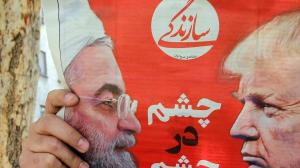
 Here we go again. Even as you read this, the war drums are beating. And – surprise, surprise – it’s Iran that’s at the heart of this latest eruption of trouble in the Middle East.
The problem is that in a region forever simmering with war and rumours of war, this one looks more serious than most. In the great international strategic poker game, a lot of dangerous cards are being dealt on to the region’s bloodstained and dusty gaming table.
Intelligence officers monitor crises by looking at two principal indicators: capabilities and intentions. The key question confronting the major powers’ intelligence officers is now very straightforward: are the US and Iran preparing for war? If so when, were and how? As The Guardian put it recently, ‘Old grudges, new weapons – is the US on the brink of war with Iran?’
The indicators are not reassuring. US-Iran enmity goes back a long way. In 1979, Ayatollah Khomeini’s Islamic Revolution overthrew the Shah, who was a bastion of Western support in the Middle East. Khomeini’s Revolutionary Guards invaded the US embassy, grabbing every classified document they could lay their hands on and seizing 52 American diplomats to hold as hostages. An ambitious attempt to rescue the hostages turned into an American military disaster, when helicopters collided in the desert, killing eight men.
This fiasco has never been forgotten by the Pentagon. It stirred patriotic sentiment in Iran that allowed the Islamic government to consolidate its power, and drove the USA into supporting Saddam Hussein in an attempt to bring down the rule of the Ayatollahs.
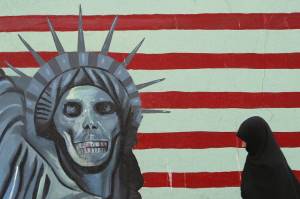 The 1979 revolution created strong passions in both countries. In Iran it was a glow of triumphalism over ‘The Great Satan’; and in the USA a simmering resentment at what was seen as a national humiliation. Few episodes in living memory, other than the sight of Royal Marines surrendering to Argentine invaders in 1982, show how public emotion can drive political decisions.
Since then Iran’s growing regional power is now seen by the USA as a serious threat to regional peace and particularly to Israel. Leading Iranian political and military figures regularly threaten to ‘wipe the Jewish homeland off the map.’ Iran has taken advantage of the Syrian War to build military bases across Syria; and a low key cross-border war between Israel and Iran has already begun. Benjamin Netanyahu, Israel’s prime minister and close ally of President Trump, remains convinced that the Mullahs are hell-bent on acquiring nuclear weapons.
This nuclear dimension is the key. Trump’s decision last year to withdraw the USA from Obama’s 2015 nuclear accord with Iran and strangle Tehran’s already enfeebled economy was the catalyst. In retaliation, Iran has reneged on the nuclear deal, and threatens to develop weapons-grade uranium. America and its allies fear Tehran’s programme could allow it to one day build atomic bombs. So does a nervous Tel Aviv.
It is against this background that the alarming intelligence indicators of a potential armed clash are being weighed.
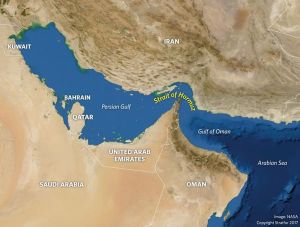 Satellites report Iran moving S-300 SAMs and massing armed fast gunboats in the Gulf. Their role would be to swarm out and attack American and Western shipping in the Strait of Hormuz, through which much of the world’s oil supplies pass.
Last week, the US State Department ordered all non-essential staffers to leave the embassy and consulate in the northern Iraqi city of Irbil. Exxon Mobil has evacuated all its foreign staff members from Iraq’s Western oilfield. A ‘Notice to Airmen’ warns of the risks to air travel in the region amid ‘heightened military activities and increased political tension.’ Lloyd’s Insurance of London is warning of increasing risks (and premiums, naturally) to maritime shipping in the Gulf.
US-allied Bahrain has warned its citizens against travel to Iraq and Iran, citing ‘unstable regional circumstances, dangerous developments and potential threats.’
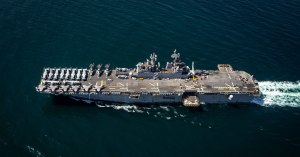 In response to these rising tensions, Washington has upped the ante, flying B-52 bombers into the region and moving a nuclear equipped carrier task force with 80 aircraft, accompanied by a Marine Expeditionary Force, to the Gulf. The objective of the exercise, in the words of national security adviser, is to ‘send a message’ to Iran. Donald Trump’s tweet spells out the threat implicitly: ‘If Iran wants to fight, that will be the official end of Iran.’
Iran has responded defiantly, quadrupling production of low-grade uranium while its IRGC commanders warn, ‘Over the years, our forces have completely surrounded the Persian Gulf, so that the Americans need our permission to move in this area.’ Meanwhile, a sabotage operation targeting four oil tankers off the coast of the United Arab Emirates was probably sponsored by Iran, and Iran-backed rebels in Yemen claim responsibility for a drone attack on a crucial Saudi oil pipeline and an airport.
The leader of Iran’s elite Quds Force has already told Iraqi militias in Baghdad to ‘prepare for proxy war’ as the relationship with the USA deteriorates. Iraq has no shortage of friends among the Shi’a militias owing allegiance to Tehran; all are capable of stirring up fighting across the region.
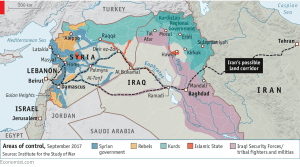 Tehran has significantly expanded its footprint over the past decade, making powerful allies across the Middle East as it forges its ‘Land Bridge’ west to the Mediterranean. The IRGC’s Quds Force controls up to 140,000 Shia fighters across Syria, many dug in on Israel’s border. Quds has close links to Hezbollah, Lebanon’s well-armed anti-Israel military organisation, part of Iran’s ‘axis of resistance’, armed groups with tens of thousands of Shi’ite Muslim fighters backing Tehran. In Gaza, Iran supports Palestinian Islamic Jihad in its struggle against what Tehran calls the ‘Zionist enemy’. Further south in Yemen, the insurrectionary Houthi rebels are openly fighting Iran’s enemy, Saudi Arabia.
At the time of writing the uncomfortable fact is that all the capabilities on both sides are in place for a dangerous confrontation between Iran and the USA. The odds are that any war would be asymmetric; Iran can stir up major trouble across the region and make deniable attacks on US and Western interests, particularly by disrupting global oil supplies. In its turn Washington, egged on by Israel, has the capability of surgical strikes to decapitate the Iranian leadership and take out key Iranian nuclear facilities.
The key question is now, what are the leaderships’ real intentions? Despite the rhetoric, it looks like neither side really wants a dragged out fight. Both are discreetly signalling that they are looking to negotiate a solution. Oman’s Foreign Minister brings news that that ‘the Islamic Republic is open to talks with the USA – but not under pressure.’ Asked if the USA was going to war with Iran, President Trump replied, ‘I hope not‘, tweeting: ‘I’m sure that Iran will want to talk soon.’
This is classic, ‘speak softly but carry a big stick’ diplomacy – on both sides.
The indications from Tehran reflect this. In a letter to the UN Security Council, Iran is hinting that the Ayatollahs don’t want war: ‘Iran will never choose war as an option or strategy in pursuing its foreign policy. But if war is imposed on us, Iran will exercise its inherent right to self-defence in order to defend its nation and to secure its interests.’
Peace or war? The stakes are very high.
With the tangle of competing alliances and a region already riven by armed struggles, this could turn out to be the conflict that no-one wants. We’ve been here before.
Just like the disastrous events of summer 1914, it only needs one spark to set off the powder train of a wider war.
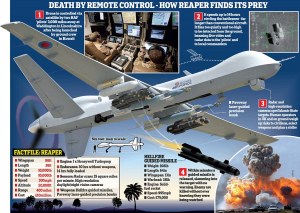 Like many others, I was surprised by the announcement by Air Chief Marshal Sir Stephen Hillier, Chief of the Air Staff, that his Reaper drone crews will be eligible for the new Operational Service Medal for their contribution to the war in Syria and the defeat of ISIS (also known as Daesh). Traditionally, medals have always been awarded based on risk and rigour. It may seem a reasonable assumption that there is not much risk sitting in a nice warm office up at RAF Waddington in Lincolnshire where they operate their Unmanned Air Vehicles (UAVs). More like playing computer games, perhaps? Where is the risk and rigour in that?
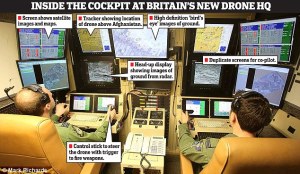 During the campaign to destroy the extremists in Iraq and Syria, drones were used to carry out strikes, gather intelligence and conduct surveillance. While front-line operational aircrew do operations for maybe six months or a year at a time, drone operations staff face different challenges The Reaper force is on duty 24/7/365, monitoring an enemy that is elusive, dangerous and determined to attack the West in any way it can in pursuit of its twisted, fanatical world view. The personal strain and pressure watching the every move of these individuals is immense and unrelenting.
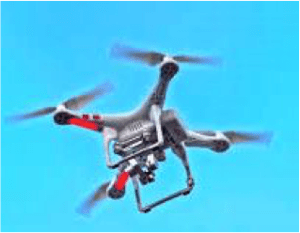 This insight into the combat stress of the new warfare is a reflection of how in the last decade drones have become a new battlefield in the ‘vertical flank’. As long ago as 2004, the militant group Hezbollah began to use ‘adapted commercially available hobby systems for combat roles’. These modified toys can be bought easily, as the Gatwick debacle in December 2018 demonstrated, and – at prices ranges from US $200 to $700 – they are as cheap as chips to the military.
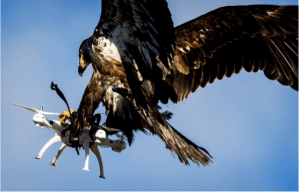 ‘As drones become deadlier, stealthier, faster, smaller and cheaper, the nuisance and threat posed by them is expected to increase, ranging from national security to individual privacy,’ Grand View warns. ‘Keeping the above-mentioned threat in mind, there are significant efforts – both in terms of money and time – being invested in the development and manufacturing of anti-drone technologies.’ The Dutch have even trained eagles to attack drones.
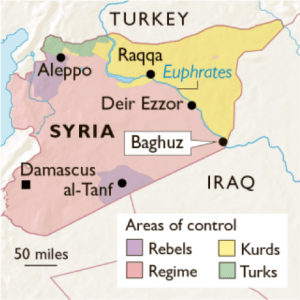
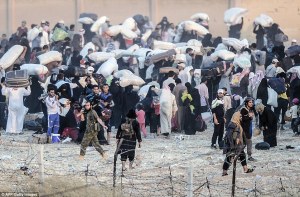 So ISIS – or Daesh (‘one who crushes something underfoot’) as the Arabs call it – is finally defeated. Like trapped rats, the last jihadi fanatics hide in their final boltholes to await their inevitable doom at the hands of the Kurds, Turk, and Syrian armies – helped by the US, Russian and UK’s Royal Air Force – all closing in for the kill. Thousands of men, women and children have fled ISIS’s surrounded final stronghold in the village of Baghuz, on the Iraqi border, surrendering to the Syrian Democratic Forces (SDF), and the Kurdish-led militias backed by the West. The women and children seen streaming into squalid desert refugee camps to be told what the future holds for the families of the broken terrorist army are the tangible evidence of defeat.
 No one sees this more clearly than General Joseph Votel, who is in charge of US operations in the Middle East. In evidence to the US Congress’s House Armed Services Committee hearing on 7 March 2019, he shared evidence that although Daesh militants are losing the last of their territory in Syria, the militants who remain represent a ‘serious generational problem’. He told the hearing: ‘We will need to maintain a vigilant offensive against this now widely dispersed and disaggregated organization. Reduction of the physical caliphate is a monumental military accomplishment – but the fight against ISIS and violent extremism is far from over and our mission remains the same.’ The general also warned of more trouble ahead: ‘The Isis population being evacuated from the remaining vestiges of the caliphate largely remains unrepentant, unbroken and radicalised.’
 One 60-year-old woman, who did not want to be named, said that ISIS will continue because the ‘Caliphate’s Cubs’ under the terror group’s rule have been trained to fight from a young age. She said: ‘The caliphate will not end, because it has been ingrained in the hearts and brains of the newborns and the little ones.’ Some of the civilians threw rocks at the cameras of those trying to film them, whilst one screamed at a photographer and called him a pig.
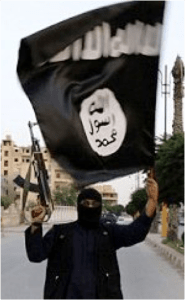
 Already there are ISIS propaganda posters encouraging new attacks, including one depicting a man walking through an airport dragging a suitcase depicting the terror group’s logo. We have seen similar Islamist terror posters in the past, often using images of major Western cities such as New York and London as part of their scare tactics. To further strengthen the case that ISIS is going to ground but still remaining active, monitoring agencies report that known ISIS sympathisers are sharing encrypted messaging apps such as Telegram to ‘inspire’ extremists to carry out terror attacks. This follows reports that desperate ISIS-linked media groups are calling for a new ‘online jihad’ now that the terrorists have been neutralised in Syria and Iraq.
 John Hughes-Wilson