 In any normal January commentators offer their views on the coming year. However, most years, after the usual mix of doom and gloom, the world seems to carry on in the same old way.
This year, however, really is different. Quite a lot of the world is already not carrying on in ‘the same old way.’ In 2019 we are going to realise that something big has changed ‘out there’.
The Eurasia Group, political risk consultancy and adviser to the world’s elites, warns in its latest report: ‘The geopolitical environment is the most dangerous it’s been in decades.’ This is the year that events, and lack of remedial action, threaten global stability and risk collapsing the old world order in a way not seen for many years. The post-1945 Pax Americana is crumbling before our eyes as President Trump unravels the transatlantic alliance that has underpinned Europe since the 1950s. Many blocs – NATO, the UN, the G7, G20, WTO and the EU – are in varying degrees of crisis as new global challenges emerge and as America walks away from acting as the world’s sheriff. The Middle East is a basket-case, fighting its own ‘Thirty Years War’ between Sunni and Shi’a with a wary Israel looking on. In the East, China and North Korea are flexing their muscles; and in the emerging world a new breed of hard-line autocrats are taking over in Brazil, Turkey, Saudi Arabia, the Philippines and Hungary.
The world order is changing – and not for the better.
The outlook is bad enough; but to make things worse, a world trade recession is looming. Global economic forecasts for 2019-20 make for dismal reading: 2019 could turn out to be the year that the world economy falls apart, although timing global economic slumps is like watching an oil tanker running slowly onto the rocks.
This is the wretched backdrop against which the European Union is confronting the biggest challenge to its existence since it began as a dream of a single European superstate back in the 1950s.
The year 2019 will be full of important decisions for the EU, as Brussels will have to set a seven-year budget – without Britain’s cash – as well as appointing new leaders to key institutions, and discussing reform, whilst coping with falling economic growth, the threat of populist national elections, trade frictions with the US, plus the challenges from Russia and China. Brexit is merely background noise to the increasingly embattled, unelected and unpopular bureaucrats sitting in the Berlaymont (European Commission HQ).
The EU is fighting on three fronts at the same time, even as many of its member states have their own domestic problems to contain (the French anti-Macron revolution is a symptom of a wider EU malaise):
- First, nationalism (aka, ‘populism’)
- Second, the Catalan rebellion and the Visegrad Four’s mutiny epitomise the growing challenge to Brussels’ rule
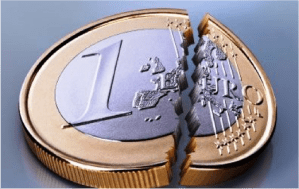
- Third, underpinning everything, is the threat to the Euro. Brussels’ flagship currency is in deep trouble
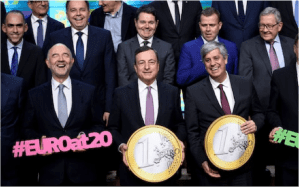 The smiling celebration party for the euro’s 20th anniversary masked the rising panic among the fat cats, bureaucrats and bankers waving champagne flutes for the cameras. They now know that their grandiose plans to cement the EU together by issuing a single currency was a huge gamble and a serious mistake. ‘The house of cards will collapse’, admits Professor Otmar Issing, ironically one of the original cheerleaders of the euro and the founding chief economist of the European Central Bank (Business Insider, 17 October 2016).
For a real monetary union to work smoothly you need a genuine single authority, plus the ability to swing government money around a united economy. Thus England can pipe London taxpayers’ cash to support Scotland, Wales and Ireland; and the US can shore up the Rust Belt states with money from New York and California. Brussels however does not have the power, or the authority, to transfer rich German taxpayers’ cash to struggling Greece, or to get the Netherlands to pay for the million illegal immigrants who are descending on Italy.
The real economic problem is the EU’s ‘Club Med’. Southern Europe’s economic fragility was well known when Greece was allowed to join the euro, after some pretty dodgy accounting. It was always a risky venture.
To take one simple example, when Greece had its own currency, Athens could stimulate an economic slump by devaluing the drachma: suddenly Greek holidays were dirt cheap and millions of tourists brought their spending power to Greece. Not anymore. Athens was trapped into a currency it could not control or devalue, and which the big boys of the EU wanted to keep strong at all costs.
Devaluation of any German controlled pan-European currency was unthinkable. So Greece was told to cut its budget and live with austerity. That meant that the only way Greece could get extra euros was by borrowing – heavily. Sure enough the big German and French banks were only too happy to lend trillions of euros to the Club Med countries. Unfortunately it became a vicious circle, known as a ‘debt doom loop’, between countries with high levels of debt and the banks that hold that debt.
The problem got worse. Big banks have bought more and more public debt from Eurozone countries. However, should the debts not be paid back (‘non-performing loans’ in Bankspeak) then the banks holding those loans are themselves in deep trouble. Now the euro-banks are running scared. Without payment, they could follow Lehmann Brothers into oblivion. The ‘rescue’ of Greece 2010-13 turns out to have been nothing more than a face saving bail-out ‘loan’ to save the big French and German banks. Even the IMF has admitted that Greece was sacrificed to save the euro and the European banking system from disaster in the great financial crisis.
Italy is the canary in today’s Eurozone coal mine. Italian banks hold one-third of the unpaid euro loans; Italy largest banks hold 300 billion euros of bad debt, dodgy securities and off-balance sheet items that aren’t being repaid. Also, billions of euros of Italian government bonds are held by Deutschebank, Commerzbank, Societé Générale, Crédit Agricole and the Netherlands’ ING.
All this could be solved at the EU level; however there is fierce opposition from Northern European countries to swinging their taxpayers’ money around. In 2018 they diluted President Macron’s proposals for greater money pooling and higher spending in the Eurozone. The idea of stripping elected parliaments’ control over taxation, spending, and the economic policies of the nation state was never going to be accepted; ‘ever closer union’ had hit the buffers of national self-interest, as the UK’s Brexit proves.
 Without a means to transfer funds and a ‘fiscal union’ by the EU countries (by pooling everyone’s taxes in Frankfurt and Brussels) the euro is at mortal risk. Now the economic storm clouds are gathering to make things even worse. Eurozone economies are slowing. Even the German economy is contracting. Industrial production was down by 4.7 per cent in the previous year leading up to November 2018. This means that, unbelievably, Germany – yes, Germany – is probably heading for a recession. Meanwhile, Italy has been in recession for a long time and Greece, Ireland, Spain and Portugal are still struggling to escape the last financial disaster. The Eurozone is heading for a full-blown recession; and without the means to devalue, or order ‘government’ spending to boost European economies, a slump seems inevitable. The pressure to break out of the stranglehold of the euro in order to print their own money has never been stronger for some nations.
‘What is clear is that the status quo cannot persist indefinitely if the euro is to survive in the long term’, an LSE blog article warned in October 2016.
This combination of member states’ disillusionment with Brussels, domestic problems, a shrinking economy, massive indebtedness, social and political challenges and the crisis of migration, plus the intrinsically unstable basis of the euro, means that monetary union has failed economically and politically.
Unless the EU27 agree to form a new central Treasury, the euro is doomed. That’s something to keep an eye on in 2019.
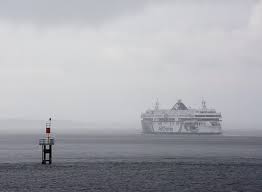 ‘Fog in Channel – Continent Cut Off’ was a famous headline before the World War I. However, it still captures the deep-rooted insularity of the British.
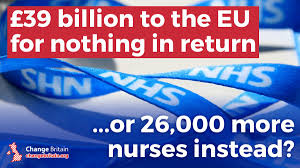 As with most divorces, the first quarrel has been about money. Grandiose EU plans are doomed if the UK refuses to pay the £39bn settlement; it’s PM May’s most potent weapon. Brexit therefore confronts ‘Europe’ with a massive problem. Losing one of the biggest financial contributors to the EU means that the Commission’s budget will have to be rewritten and a lot of expensive projects shelved. (However, the Commission will fudge it: no honest accountant has signed off the EU’s ‘audited’ accounts for 21 years.)
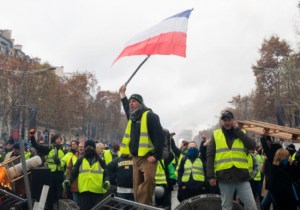 Inevitably this growing economic crisis has now spilled on to the streets of Europe. In France, President Macron’s unpopular ‘reforms’ – like increased petrol tax – have encouraged citizens to protest in the traditional French way. The gilets jaunes (yellow vests) are rioting on the streets. But their protests are about more than just France. They are also about the EU, because Macron has become the main cheerleader for the EU now that Angela Merkel’s long Chancellorship is heading for the German knacker’s yard. Macron’s capitulation to the rioters with his curious cocktail of police brutality and concessions to rioters shows that the greatest crisis for the EU is the spreading challenge to Brussels from despised ‘ordinary voters.’
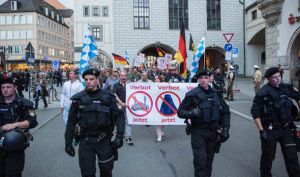 Even in safe, comfortable Germany, the nationalist far-right now poses a menacing threat to the cosy CDU-SPD order, with the electoral successes of the anti-EU Alliance for Germany (AfD) party. Also, In Belgium, ‘capital of Europe’ and headquarters of the EU, a political shambles is taking shape. Prime Minister Charles Michel resigned just before Christmas and now leads a caretaker government until fresh elections can take place in May 2019. He is leaving the screen whilst ordinary Belgians worries about chronic unemployment and Islamic immigration are stoking serious public unrest.
 Sir Winston Churchill famously growled, ‘Democracy is the worst form of government – except for all the others.’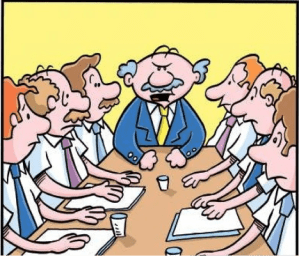
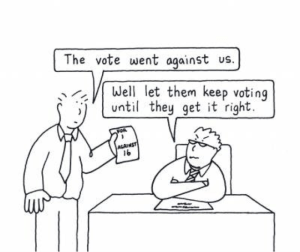 Nowhere was this more in evidence than the 2008 farce of Irish voters rejecting the Lisbon Treaty, only to be sent back to vote again after EU officials’ behind-doors deal to force a second referendum. Similar European Commission’s contempt for democratic majorities – and for democracy itself – has been seen in Denmark and France. For Brussels, ‘the people’ cannot be trusted and must be forced to vote again until they come up with the ‘right answer.’ This is dangerous stuff and reflects Bertholt Brecht’s sardonic comment on Communist elections: ‘Would it not be simpler, if the government simply dissolved the people and elected another?’
 For the second time in a month, to my surprise, I find myself agreeing with President Putin. Speaking at the International Economic Forum recently he warned: ‘We don’t need trade wars today … we need a comprehensive trade peace.’
 ‘So what?’ says the man in the Kyrenia café, ‘How do big economic problems affect me, my family and my bank account? Who cares?’
 John Hughes-Wilson