Our guest columnist

Living in the Turkish Republic of Northern Cyprus is an experience in itself and allows a view of events rarely – if at all – publicised in the UK press and media. This website will occasionally publish articles by Mr Stephen Day, an ex-Westminster MP who retired to the TRNC in 2006. These posts will offer a unique insight into the reality of life in an unrecognised country.
Stephen Day was the former Conservative MP for Cheadle, Cheshire (1987–2001) and Member of the Tory Whips Office. He successfully brought into law a Private Members Bill introducing the compulsory wearing of seat belts by children, consequently winning the Automobile Association silver medal for his contribution to road safety. Prior to Parliament he worked as a Sales Executive, as a Graduate Member of the Institute of Export. In 2006 he retired to North Cyprus and is currently President of the British Residents Society (BRS).
He has been a columnist for the Cyprus Today newspaper for the last 16 years.
Lefkoşa is the Turkish name for North Nicosia, the capital of the Turkish Republic of North Cyprus.
Stubborn stupidity
You would hope that an august organisation like the United Nations, might at last produce a Secretary–General capable of some original thought on the matter of Cyprus. Forget it. There’s as much chance of that as a resident of Lefkoşa being selected for the next crew of the International Space Station. In other words, none at all.
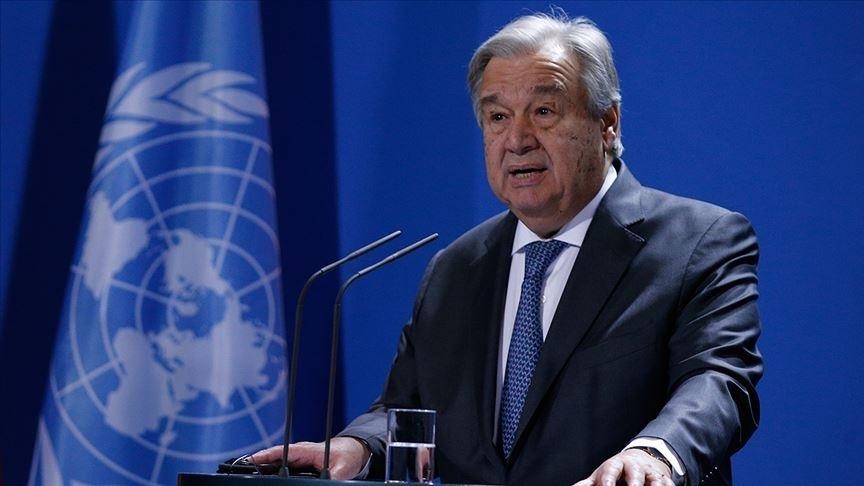
The latest ‘biannual report on Cyprus’ (Christmas, 2021), submitted to the UN Security Council by Secretary–General Antonio Guterres, is about as original as a forged Da Vinci masterpiece. It looks the same, but is worthless. In fact, the late, great, founding TRNC President, Rauf Denktaş, would have recognised every word – from 1983 onwards. The yawns of the Security Council must have been audible in far-off California, never mind in New York’s UN headquarters.
The Secretary–General is concerned that ‘the faltering economy of the TRNC and the passage of time without a settlement being reached are thwarting reconciliation efforts.’ Well, I never. Get away! For a statement of the blindingly obvious, you can’t beat that, now can you? To some extent, Guterres blames the impact of Covid for that ‘faltering economy’. Undoubtedly so, but isn’t there another important factor impacting on the TRNC? Like the UN’s never-ending enforced diplomatic and economic isolation of the North, for instance? How can you overlook the impact of that? You can’t. It’s what the Secretary–General proposes to do about it that staggers me. Something different? No chance – just more of the same old failure (the mind boggles at the extent of the inertia).
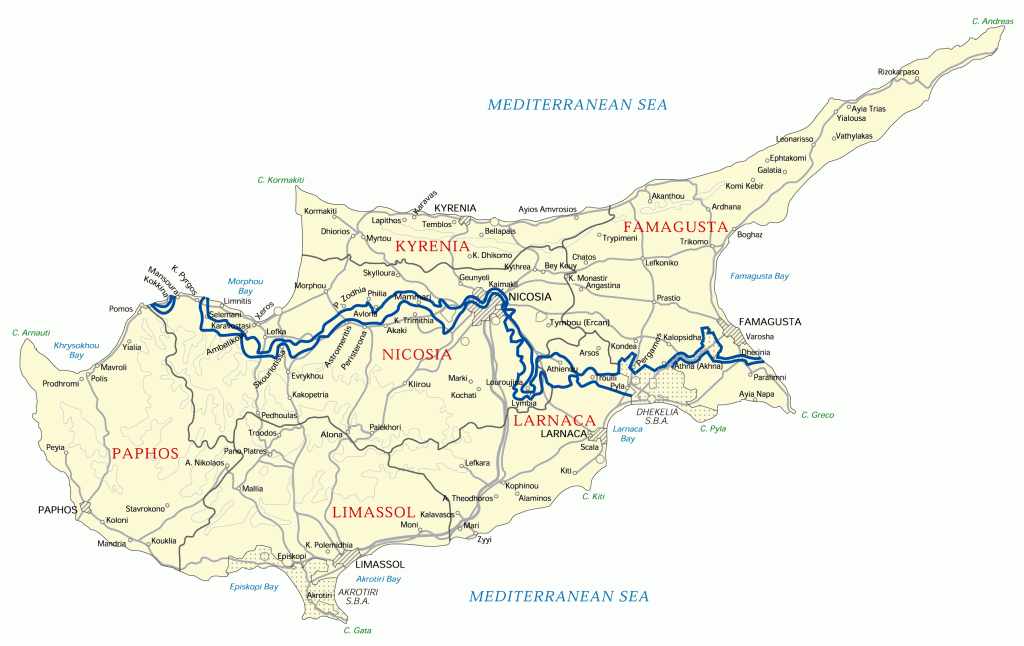
He went on to say that there is ‘a risk that the deepening of disparities between the two [Cypriot] economies may start eroding the basis for important convergences achieved in the past.’ Pardon? What convergences? The so called ‘Republic of Cyprus’ in south Cyprus is still the recognised ‘government of the whole of Cyprus’ (even though it isn’t) and the TRNC doesn’t exist! What kind of ‘convergence’ is that? And what’s all this ‘may start’ eroding convergence? The UN’s (and EU) stubborn stupidity in pursuing repeated failure began eroding the chance of a settlement decades ago. It still does and, if the Secretary–General has anything to do with it, it will continue to do so. Favouring one side with all the recognition and ignoring the existence of the other hardly smacks of even-handedness, now does it? Inviting the Greek–Cypriot President to address the UN General Assembly last year and failing to invite the Turkish–Cypriot President to do the same was a classic example of UN bias. What incentive does the favoured side have to concede anything? It doesn’t. That is why they don’t. The status quo suits the Greek part of Cyprus nicely.
If not achieving a settlement worries the Secretary–General, isn’t it about time that the UN started asking itself why? It should be as obvious as the wart on Oliver Cromwell’s face, Cyprus needs a radical UN rethink. We need a new UN vision, like treating both sides equally and recognising the obvious fact there are two states in Cyprus, not one.
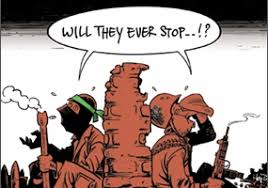
This shouldn’t be too hard for the Secretary–General to comprehend. For instance, as one writer pointed out last week, ‘the UN supports and advocates the proposal for a two state solution for the Israeli/Palestine situation but rejects ratifying the two state solution in the island of Cyprus, where it actually exists’ [my italics]. Quite! That is amazing in itself – and it is even more incredible that the ‘Palestine’ bit of the equation is divided in itself, territorially and politically, between Hamas and Hezbollah. They are at each other’s throats. Not only that, but Hamas – a militant, so-called ‘Islamic’ terrorist group – rule that part of ‘Palestine’ called ‘the Gaza Strip’ and regularly fire missiles into Israel (Tel Aviv in particular). They receive Israeli retaliatory attacks in return as a consequence. In other words, in Palestine both the threat and the reality of violence exist on both sides.
How is it right that the UN is quite prepared to grant recognition to two peoples in conflict but not to a Cyprus at peace? There’s no armed conflict here. What message does that send? Chuck a few missiles and bombs around and we will recognise you? I’m sure the UN doesn’t intend that, but that is the consequential inadvertent reality of the UN’s differing attitudes to both disputes. If so, it is literally ‘bloody’ madness!
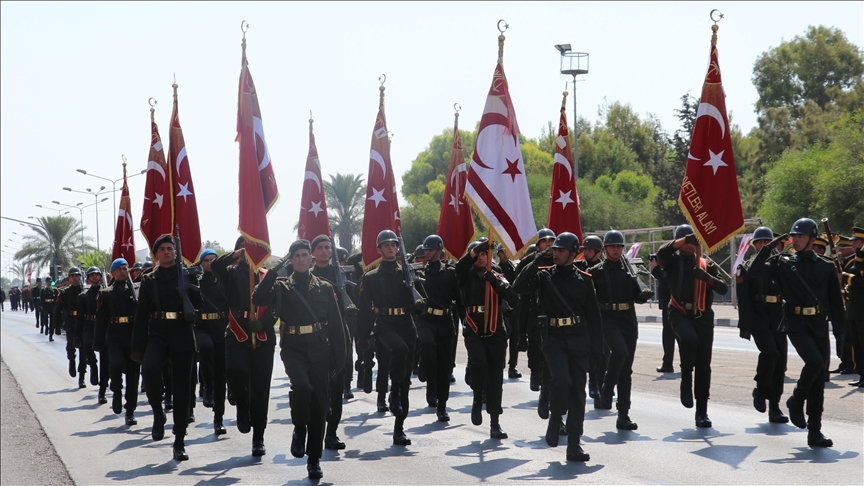
The UN stupidity goes further. They want Cyprus reunited but under Greek rule. They want Turkey out of the Cyprus equation – especially her troops, whose presence has really ensured fifty years of peace in Cyprus, not the presence of the UN. Everyone on Cyprus knows better than to mess with the Turkish Army. If those troops had not come here, it would have been a ‘Palestine plus’ scenario! Turkey could have taken the whole island. They didn’t. They simply saved the Turkish Cypriots from extinction. That is the reality. That is the truth. Before they came, civil war raged: ethnic cleansing to evict the Turks was rampant. Since when has putting two peoples back together again, who experienced such division and conflict, ever been a clever idea? Never, unless you happen to be the UN.
If Turkish Cypriots remain eternally isolated and treated as some sort of pariah who does the UN think they have to turn to? There is only one place that can help and it’s Turkey: the very opposite of what the UN claims it wants to achieve! Madness incarnate.
The Secretary–General readily identified the current lack of common ground between Cyprus’s two sides and ‘the deepening distrust, both between the two sides and among the two communities.’ He got that right, at least. He called on the leaders to ‘look to the future with pragmatism.’ Well, I never. If anybody is lacking in pragmatism and needs to ‘look to the future’ it’s the UN. For goodness sake, it is blindingly obvious that the UN position on Cyprus is untenable. It is not working. It never has worked. It never will. It has failed, failed and failed again, almost more times than the sun has set.
It’s time to accept there are two states, Mr. Guterres. There is no other way. Make history and recognise the facts. On the ground, sticking to the same old song is pointless. As things stand, so is the UN.
One day, someone in New York might realise it.
 Well, it’s already started. The many wars in Syria, Lebanon, Iraq, Iran are beginning to come together into one single, bigger conflict. We are on the road to another war.
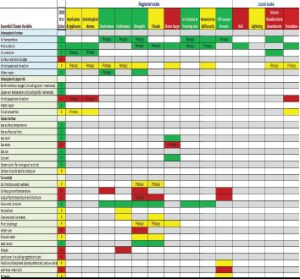 Intelligence officers use a system called an ‘Indicators and Warnings board’ to monitor events and assess where they are heading. Essentially it is a list of key questions, listing the critical information requirements. Examples might be: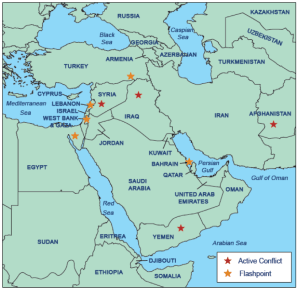
 The USA has been willing to use its firepower in the past. It escorted ships here during the 1980s ‘Tanker War’. America fought its last naval battle in these waters against Iran in 1988. In July that year, the warship USS Vincennes even shot down an Iranian airliner, killing all 290 aboard, in what Washington said was an accident. Tehran said it was a deliberate attack.
 If this were not bad enough, everywhere you look in the Middle East there are many other dangerous flashpoints, many of them already the scene of fierce fighting. In Yemen, Sunni fights Shi’a (Saudi versus Iran), as the Houthis become part of Iran’s regional proxy warriors. On the Syrian border, Turkey is already busy fighting the Kurds. Gaza and the West Bank still simmer with anti-Israeli anger. Israel has already mobilised some reservists as a cornered Netanyahu looks for a grand gesture – probably a demonstration of Israel’s military might – to help him form a government after the recent elections.
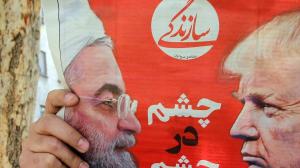 Here we go again. Even as you read this, the war drums are beating. And – surprise, surprise – it’s Iran that’s at the heart of this latest eruption of trouble in the Middle East.
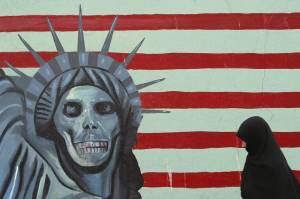 The 1979 revolution created strong passions in both countries. In Iran it was a glow of triumphalism over ‘The Great Satan’; and in the USA a simmering resentment at what was seen as a national humiliation. Few episodes in living memory, other than the sight of Royal Marines surrendering to Argentine invaders in 1982, show how public emotion can drive political decisions.
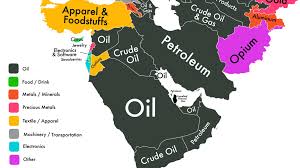
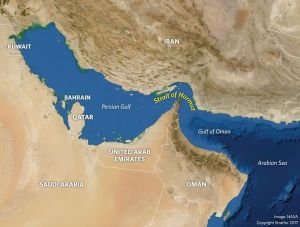 Satellites report Iran moving S-300 SAMs and massing armed fast gunboats in the Gulf. Their role would be to swarm out and attack American and Western shipping in the Strait of Hormuz, through which much of the world’s oil supplies pass.
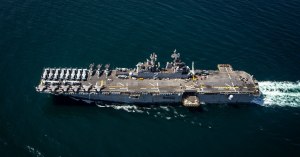 In response to these rising tensions, Washington has upped the ante, flying B-52 bombers into the region and moving a nuclear equipped carrier task force with 80 aircraft, accompanied by a Marine Expeditionary Force, to the Gulf. The objective of the exercise, in the words of national security adviser, is to ‘send a message’ to Iran. Donald Trump’s tweet spells out the threat implicitly: ‘If Iran wants to fight, that will be the official end of Iran.’
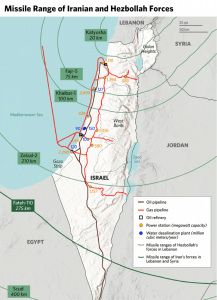
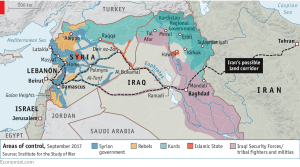 Tehran has significantly expanded its footprint over the past decade, making powerful allies across the Middle East as it forges its ‘Land Bridge’ west to the Mediterranean. The IRGC’s Quds Force controls up to 140,000 Shia fighters across Syria, many dug in on Israel’s border. Quds has close links to Hezbollah, Lebanon’s well-armed anti-Israel military organisation, part of Iran’s ‘axis of resistance’, armed groups with tens of thousands of Shi’ite Muslim fighters backing Tehran. In Gaza, Iran supports Palestinian Islamic Jihad in its struggle against what Tehran calls the ‘Zionist enemy’. Further south in Yemen, the insurrectionary Houthi rebels are openly fighting Iran’s enemy, Saudi Arabia.
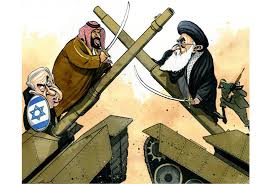
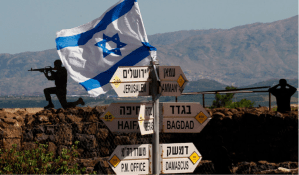 The Roman poet, Horace, once observed, ‘when your neighbour’s house is on fire, you should worry.’ It now looks as whole Middle East could catch fire, because the embers of the Syrian civil war have morphed into something much more dangerous, risking setting off a major new war between Israel and Iran.
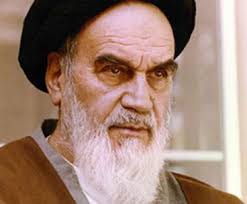 The problem goes back to 1979 when Iran deposed the US-backed Shah, America’s closest ally in the Middle East. However, Iranians soon found that they had swapped one dictator for another, the Shi’ite religious fanatic Ayatollah Khomeini. His battle cry was ‘Death to Israel, Death to America.’ Since then, Khomeini’s Islamic Revolution has had far-reaching consequences for Iran and for the Middle East. Tehran is now wedded to violent anti-Western policies, international terrorism, crushing internal dissent and exporting their Shi’ite version of revolution.
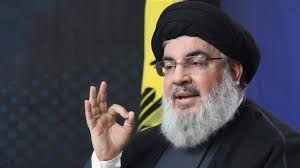 Emboldened by Iran’s protective umbrella, speaking at a rally marking the 40th anniversary of Iran’s Islamic Revolution and the overthrow of the Shah, Hezbollah’s leader (Hassan Nasrallah) warned that Lebanon would ‘defend Iran in the event of war,’ and ‘if America launches war on Iran, it will not be alone in the confrontation, because the fate of our region is tied to the Islamic Republic’.
 Rouhani also vowed Iran would defeat harsh US sanctions, re-imposed after President Donald Trump withdrew from Tehran’s nuclear accord with world powers last year. Meanwhile Iran’s secret drive to acquire nuclear weapons continues apace.
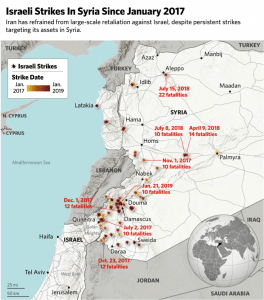 In May 2018 Iranian forces fired 50 rockets and mortars into the Golan Heights. This barrage did not inflict a single casualty and caused negligible damage. Israel’s prompt response was airstrikes hitting more than 70 targets. With those strikes, Israel demonstrated its ability to retaliate, warning Iran that attacking Israel would only invite an even more forceful reply. Iran backed down. Its limited capabilities in Syria makes Tehran nervous of any escalation – for now. Israel has a significant military advantage, enjoying overwhelming air superiority that can kill Iranian forces and destroy their equipment.
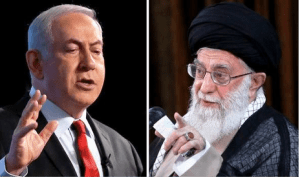 The danger is that any escalation from Iran could spark a major escalation of fighting, which in turn would be met almost certainly with an overwhelming Israeli response in Lebanon and Iraq. Israeli Prime Minister Netanyahu spells out the consequences: ‘Whoever tries to hurt us, we will hurt them. Whoever threatens to destroy us will bear the full responsibility.’
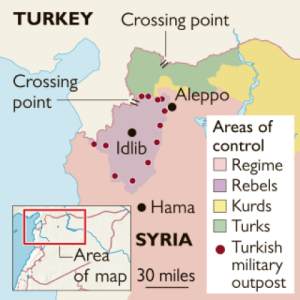 Winston Churchill once famously said, ‘battles are the punctuation marks of history.’ Well, we have just avoided a potentially disastrous ‘exclamation mark’ in the bloody history of the Middle East. Whilst the post-colonial
 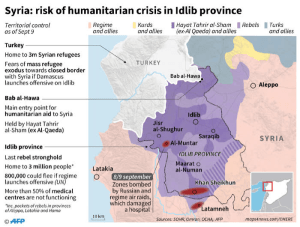 Many of the civilians in Idlib are already refugees from other parts of Syria following the collapse of the opposition resistance in cities such as Aleppo. The consequences of an all-out offensive against Idlib with its hapless civilians and the risk of Turkish troops fighting Russians could have led to a bloodbath.
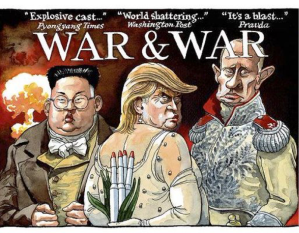 For once I find myself in total agreement with Vladimir Putin, who observed recently in a Blinding Glimpse of the Obvious that ‘the world is becoming a more chaotic place.’ Whilst Pres-for-life Vlad’s BGO doesn’t exactly qualify him as a great thinker, this time he is absolutely right. There’s a definite feeling abroad of an unravelling in world affairs; an uneasy sense that something nasty is lurking round the corner of history ….
 Well, that’s it. The war is over, ISIS is beaten and on the run. We can all relax and bring the boys home. Mission accomplished.
 John Hughes-Wilson